
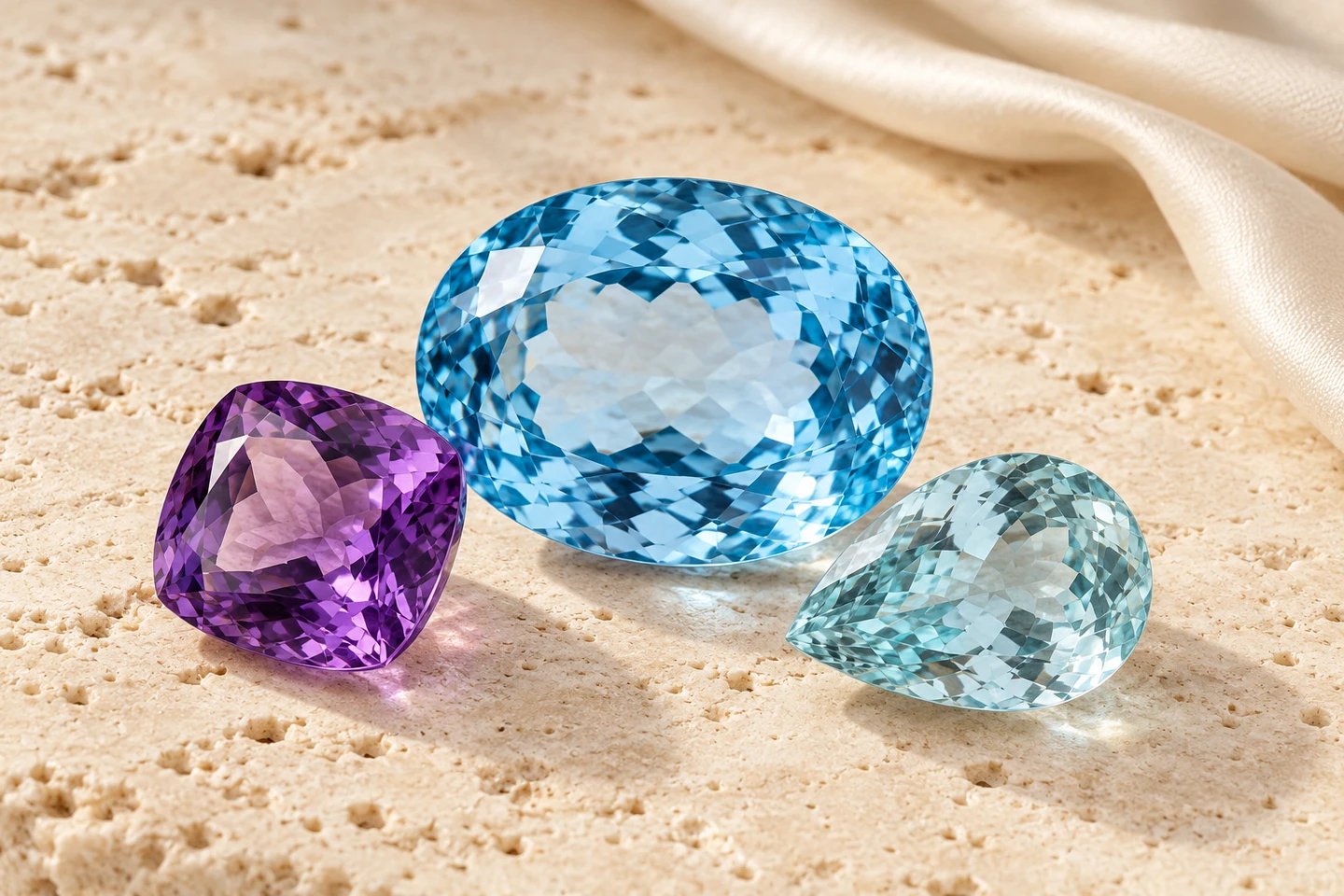
Semi-precious is a broad jewelry category, not a quality grade or a guarantee of low price. The stones in this collection differ in mineral identity, color, durability and care. Compare each listing's actual appearance, measurements, treatments and available reports before choosing a loose gem.
Amethyst
Amethyst is purple quartz, ranging from pale violet to deep reddish purple. Compare how evenly the color appears across the face of the stone and whether a dark gem still looks lively in ordinary light. Faceted amethyst often has no eye-visible inclusions, but cut quality and millimeter dimensions still matter for a setting. Read the amethyst guide or browse loose amethyst.
Aquamarine
Aquamarine is the blue to greenish-blue variety of beryl. Its color can range from pale and watery to a stronger blue. Compare the hue and saturation alongside transparency, visible inclusions and cut; a larger carat weight does not by itself mean a more vivid stone. Check the measurements if you have a particular setting in mind. Read the aquamarine guide or browse loose aquamarine.
Citrine
Citrine is yellow to orange quartz. Compare color strength, brownish tones, visible zoning and the liveliness of the cut. Much citrine in the market is made by heating amethyst, so check the treatment information for the individual listing rather than assuming a stone is untreated. Citrine is available in a wide range of sizes for jewelry designs. Read the citrine guide or browse loose citrine.
Garnet
Garnet is a group of related minerals, not just one red gemstone. Garnets can be red, orange, green, purple and other colors; clarity expectations vary between varieties. Compare the actual color and transparency, and check whether a particular garnet variety is identified. Shape, face-up size and cut also affect how the gem looks in jewelry. Read the garnet guide or browse loose garnet.
Moissanite
Moissanite is silicon carbide, a different material from diamond. Jewelry moissanite is commonly laboratory-created and is often chosen for its bright appearance. The semi-precious catalog groups it with colored stones for shopping convenience; that label does not establish natural origin. Compare cut, measurements and price, and check the individual product's material and origin disclosure. Read the moissanite guide or browse loose moissanite.
Morganite
Morganite is pink to orange-pink beryl, in the same mineral family as aquamarine. Many stones have a soft pastel appearance, while stronger pinks are less common. Compare the face-up color, visible inclusions and dimensions; color can look different as the stone's size and lighting change. Ask about any disclosed heat treatment before choosing. Read the morganite guide or browse loose morganite.
Topaz
Topaz occurs in blue, yellow, orange, pink and other colors. These colors are not interchangeable when judging appearance or price. Blue topaz commonly owes its color to treatment, so read the disclosure for the particular stone. Compare hue, brightness, cut and measurements, then consider a setting that protects the gem from hard knocks. Read the topaz guide or browse loose topaz.
Tanzanite
Tanzanite is the blue to violet variety of zoisite. Its mix of blue and violet can change with viewing direction, so compare the face-up color of individual stones rather than relying on a color name. Tanzanite is commonly heated to bring out blue and violet tones. It needs protection from hard blows, especially in a frequently worn ring. Read the tanzanite guide or browse loose tanzanite.
Tourmaline
Tourmaline has an unusually wide color range, including pink, green and blue, and some stones show more than one color. Compare the dominant hue, saturation, transparency and any color zoning across the face of the gem. Cut orientation can make a dark stone look brighter or a pale stone look stronger. Review any disclosed treatment and the exact dimensions. Read the tourmaline guide or browse loose tourmaline.
Peridot
Peridot is a green gem from the olivine mineral group. Its color can appear yellowish green or a stronger grass green; brownish tones may change the overall look. Compare color, visible inclusions and cut alongside size. Peridot can be worn in jewelry with care, so discuss setting protection if you plan to wear it regularly. Read the peridot guide or browse loose peridot.
Opal
Opals vary widely. Some show flashes of spectral color called play-of-color, while others are valued for their body color. For a stone with play-of-color, compare the brightness, pattern and colors from several angles, as well as the background color. Check whether the listing describes a solid opal or an assembled stone, and request care advice for that specific gem. Read the opal guide or browse loose opal.
Quartz
Quartz is a mineral with many gem varieties, including purple amethyst, yellow-orange citrine and pink rose quartz. A listing labeled simply Quartz needs a closer look: check its actual variety, color, transparency and cut. Some quartz can show a cat's-eye effect, but cat's-eye quartz and Chrysoberyl Cat’s Eye are different materials. Read the quartz guide or browse loose quartz.
Spinel
Spinel is its own mineral species, although red spinel has historically been mistaken for ruby. It can also appear pink, blue, violet and other colors. Compare hue, saturation, transparency and cut; do not assume two stones with similar color are the same gem. Review any laboratory information supplied with the individual listing. Read the spinel guide or browse loose spinel.
Chrysoberyl Cat’s Eye
Chrysoberyl Cat’s Eye is chrysoberyl with chatoyancy, a narrow band of reflected light that appears to move as the stone or light moves. The effect is usually presented in a domed cabochon. Compare the band's sharpness and position, the body color and the stone's dimensions. This is a separate mineral from quartz, even when quartz shows a similar eye effect. Some traditions associate it with protection and good fortune as symbolic meanings, not proven effects. Read the Chrysoberyl Cat’s Eye guide or browse loose Chrysoberyl Cat’s Eye.
How to choose a semi-precious gemstone
- Start with identity and color. Confirm the listed stone type, then compare hue, tone and saturation in the actual product images.
- Check cut and fit. Look at face-up appearance, cut, carat weight and millimeter measurements for your intended setting.
- Read the disclosures. Review listed treatments and any available laboratory report. A missing treatment field does not prove a gem is untreated.
- Plan care for the stone. Hardness, toughness, inclusions and treatments affect wear and cleaning. Ask for advice tailored to the individual gem and setting.
Browse all loose semi-precious gemstones, explore matching pairs, or ask us about a particular stone.