
|
|
|
How to Choose a High-Quality Emerald
Color, Clarity & Origin Guide
|
|
|
|
|
A fine emerald is one of the most coveted gemstones in the world — rarer than a diamond of equivalent quality and prized for a depth of green color that no other stone can replicate. Yet choosing a high-quality emerald requires a fundamentally different framework than selecting a diamond. Inclusions are expected, treatments are nearly universal, and origin plays an outsized role in both price and prestige.
This guide covers every factor that determines emerald quality: color grading, clarity evaluation, treatment disclosure, Colombian versus Zambian origin, and how those variables converge into a final price. Whether you are searching for a fine emerald engagement ring or a loose certified emerald, the principles here will help you evaluate any stone with confidence.
Emerald Color: The Most Important Quality Factor
Color is the dominant value driver in emeralds — more so than in any other major gemstone. A top-grade emerald with minor inclusions will always command more than an eye-clean stone with weak or off-tone color. Understanding color grading is therefore the most important skill for any emerald buyer.
Emerald color is evaluated across three dimensions:
- Hue: The finest emeralds are a pure, vivid green. A slight bluish-green secondary hue is acceptable and even desirable in Colombian material, but noticeable yellow-green or brown secondary hues significantly reduce value.
- Saturation: Top-grade emeralds are described as “vivid” — intensely saturated without appearing dark or inky. Stones graded “strong” are excellent; those with “moderate” saturation are noticeably less valuable.
- Tone: Medium to medium-dark tone is ideal. Very light stones lack the richness that defines a premier emerald; very dark stones lose transparency and brilliance. The sweet spot is a tone of approximately 60-75 on a 100-point scale.
The most sought-after color is what the trade calls “vivid green” — pure hue, strong saturation, medium-dark tone, with exceptional transparency. These stones are exceptionally rare and priced accordingly. See our gemstone color guide for a deeper look at how color grading works across all colored stones.
Clarity and Inclusions in Emeralds
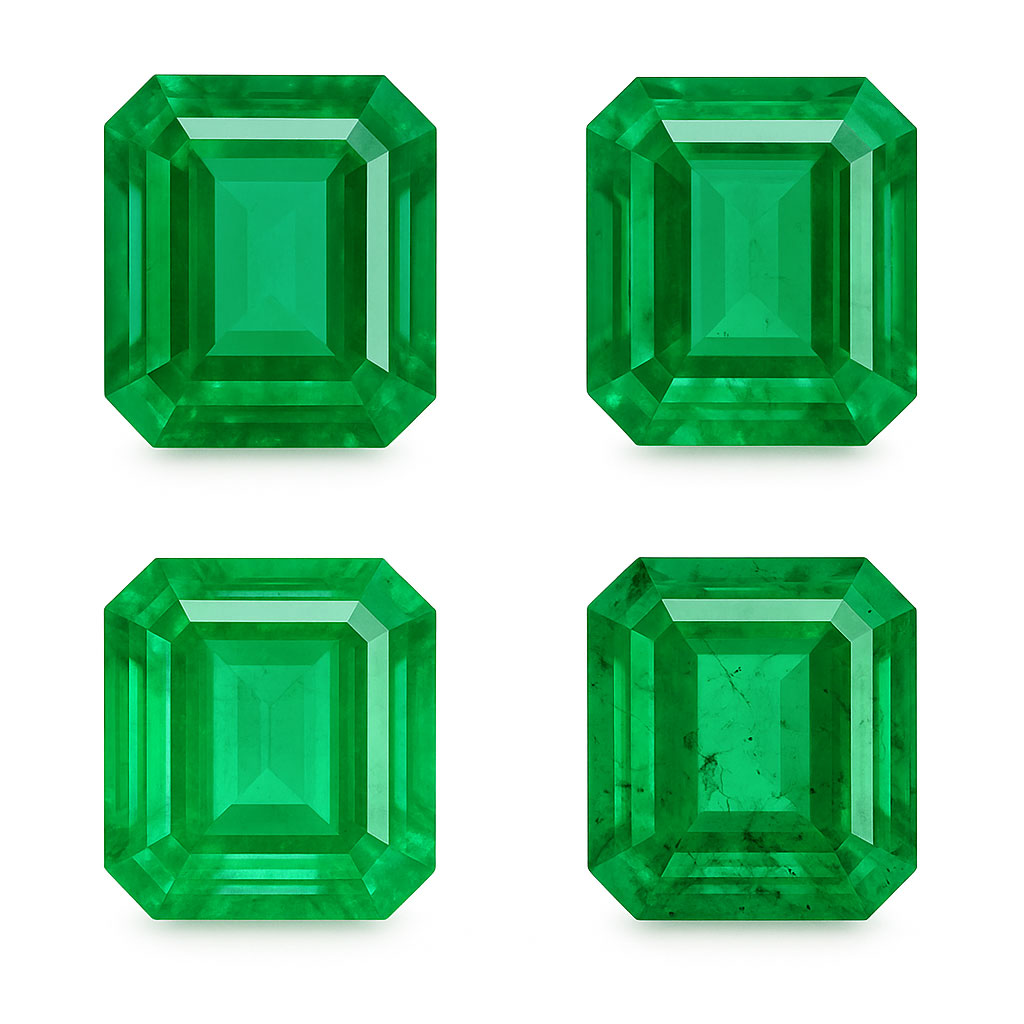
Unlike diamonds, where a flawless stone is the theoretical ideal, emeralds are expected to have inclusions. The industry term for the network of fine fractures, needles, and mineral crystals inside an emerald is jardín — the French word for garden. A jardinless natural emerald of any meaningful size would be extraordinarily rare and would prompt suspicion about whether the stone had been treated or was synthetic.
The key clarity standard for emeralds is eye-clean: inclusions should not be visible to the naked eye at normal viewing distance. Stones that are eye-clean at a standard 10-inch viewing distance command a premium; those with inclusions visible without magnification are discounted accordingly.
When using magnification, the character of inclusions matters as much as their quantity. Fine needle inclusions distributed evenly are preferable to a large fracture across the face of the stone. Any fracture reaching the surface increases the risk of chipping and affects durability. A gemological report from a reputable laboratory will describe clarity in detail and is particularly important for emeralds above 2 carats.
Emerald Treatments: Oil vs. Untreated
Virtually all natural emeralds are treated with oil or resin to fill surface-reaching fractures, improve transparency, and enhance color. This practice has been standard in the emerald trade for centuries and is universally accepted by gem laboratories and major auction houses. What matters for buyers is the degree of treatment and the material used.
- Minor to moderate oiling (cedar oil or colorless resin): The most acceptable and most common treatment. The stone's natural color is not altered — only clarity is improved. Laboratories such as GIA, AGL, and Gübelin will certify oiled stones with a treatment disclosure. Significant premium is retained.
- Heavy oiling (green-tinted oil or epoxy resin): More aggressive treatment that artificially enhances color as well as clarity. These stones trade at a meaningful discount to lightly treated examples of similar apparent quality.
- Untreated (“no indications of clarity enhancement”): The rarest and most valuable category. An untreated emerald of fine color and clarity carries a substantial premium — often 50% or more — over an equivalent treated stone. All untreated claims must be verified by a major independent laboratory.
Origin: Colombian vs. Zambian Emeralds
Among the world's emerald-producing countries, Colombia and Zambia stand apart as the most commercially significant and the most influential in determining market value. Understanding the distinct character of each origin helps buyers find the stone that matches their aesthetic and budget priorities.
Colombian Emeralds are the global benchmark for emerald quality. Mined primarily in the Muzo, Chivor, and Coscuez regions, Colombian stones are prized for their warm, pure green with a slight bluish secondary hue and extraordinary transparency when fine material is found. The finest Colombian emeralds achieve the “vivid green” color standard more reliably than stones from any other origin. Colombian origin, confirmed by laboratory, adds a meaningful premium to price — top Colombian material can trade at 30-50% above comparable Zambian stones of similar grades.
Zambian Emeralds — mined primarily in the Kafubu district — have established themselves as the premier alternative to Colombian material. Zambian stones tend toward a slightly cooler, more bluish-green hue and often exhibit higher clarity than their Colombian counterparts. The iron content in Zambian host rock contributes to this distinctive cool green tone. A fine Zambian emerald with excellent clarity can rival a Colombian stone visually while offering better value per carat. For buyers who prioritize clarity over the prestige of Colombian origin, Zambia is the natural choice.
Pricing Factors for Fine Emeralds
Emerald pricing is exponential rather than linear: a 2 carat stone is not simply twice the price of a 1 carat stone of the same grade — it can be five to ten times more expensive. This is because fine emeralds become dramatically rarer at larger carat weights.
The key pricing variables in order of impact:
- Color: Vivid green commands the highest premium. Each step down in saturation or purity of hue represents a significant price reduction.
- Treatment degree: Untreated stones carry the largest premiums. Minor oiling is fully acceptable; heavy treatment discounts value significantly.
- Origin: Colombian origin with laboratory confirmation adds a consistent premium over other origins for equivalent apparent quality.
- Clarity: Eye-clean stones command premium pricing. Stones with visible inclusions are priced at a discount proportional to their impact on appearance.
- Carat weight: Fine material above 3 carats becomes exponentially rarer. The price-per-carat inflection points occur at approximately 1, 2, 3, and 5 carats.
As a rough benchmark: a well-oiled, eye-clean, fine green 1 carat Colombian emerald with GIA or AGL report starts at approximately $3,000-$6,000 per carat at wholesale. Vivid untreated Colombian material of 2+ carats can exceed $30,000 per carat. Fine certified emeralds at these grades are genuine investment-quality stones.
Buyer Tips: How to Purchase an Emerald Wisely
- Always buy certified: For any emerald above 1 carat, require an independent laboratory report. GIA, AGL, and Gübelin are the most respected for colored stones. The report confirms origin, discloses treatments, and provides an objective quality assessment.
- Evaluate in person when possible: Emeralds must be evaluated in multiple lighting conditions. The stone should look lively and transparent in natural daylight, not just under bright display lighting.
- Prioritize color, then clarity: A vivid green eye-clean stone is the ideal target at any budget. If you must compromise, accept slightly more inclusions before accepting weaker color.
- Understand treatment before purchasing: Ask explicitly about treatment degree. “Minor” or “insignificant” on a lab report is acceptable. “Significant” or “heavy” oiling should be reflected in a meaningful price reduction.
- Consider Zambian origin for value: If Colombian origin premium is not a priority, fine Zambian emeralds offer exceptional beauty at better value. Many top gemologists consider the finest Zambian stones indistinguishable from Colombian material to the untrained eye.
- Inspect the setting choice: Emeralds are sensitive to ultrasonic cleaning and require protective settings. Bezel or deep prong settings offer better protection than minimal prong styles. Discuss setting options with your jeweler before purchasing the stone. See our emerald care guide for maintenance advice.
Ready to begin your search? Browse our loose emerald collection or explore our curated selection of emerald engagement rings.
Frequently Asked Questions
What is the most important quality factor when choosing an emerald?
Color is the single most important quality factor in an emerald. A stone with vivid, pure green color and moderate inclusions will always be worth more than a flawless stone with weak or off-tone color. The ideal emerald color is a pure medium to medium-dark green with vivid saturation and, optionally, a slight bluish secondary hue as seen in the finest Colombian material.
Are emerald treatments normal and acceptable?
Yes. The vast majority of natural emeralds are treated with oil or resin to improve their clarity. This practice has been standard in the emerald trade for centuries and is fully accepted by major auction houses and gem laboratories. The key factor is the degree of treatment: minor to moderate oiling with colorless cedar oil is the most desirable. Heavily treated stones or those treated with green-tinted oil or epoxy resin command a significant discount. Untreated emeralds carry the highest premium and should always be accompanied by a laboratory certificate confirming the absence of treatment.
What is the difference between Colombian and Zambian emeralds?
Colombian emeralds are the global benchmark for emerald quality, known for their warm pure green color with a slight bluish hue, exceptional transparency, and the highest market prestige. Zambian emeralds tend toward a cooler, more distinctly bluish-green tone and often exhibit better clarity. Both origins produce gems of outstanding beauty. Colombian origin typically commands a 30-50% price premium over comparable Zambian stones due to its historic reputation and rarity of top material. For buyers who prioritize clarity and value, fine Zambian emeralds are an excellent choice.
What does “eye-clean” mean for emeralds?
An eye-clean emerald is one in which inclusions are not visible to the naked eye at a standard viewing distance of approximately ten inches. Because nearly all natural emeralds contain some inclusions -- called jardin -- the practical standard for a high-quality stone is eye-clean rather than inclusion-free. Eye-clean emeralds of fine color command premium prices. Stones with inclusions visible without magnification are priced at a discount proportional to how much those inclusions affect the stone's transparency and beauty.
Do emeralds need a grading report?
Yes, for any emerald above 1 carat, a grading report from a reputable independent laboratory is strongly recommended, especially for high price stones, where making the report is beneficial. Unlike diamonds, where GIA is the universal standard, emeralds benefit from reports by AGL (American Gemological Laboratories), Gübelin, GRS, GIA and more -- all of which provide origin determination and treatment disclosure. The report confirms the stone is natural, discloses any treatments and their degree, identifies the geographic origin, and provides an objective quality assessment. This documentation is essential for resale value and buyer confidence.
How much does a high-quality emerald cost?
Fine emerald prices vary dramatically based on color, clarity, treatment, origin, and carat weight. A quality 1 carat Colombian emerald with minor oiling, eye-clean clarity, and a GIA or AGL report typically starts at $3,000-$6,000 per carat at wholesale. Vivid untreated Colombian material above 2 carats can exceed $30,000 per carat. Zambian emeralds of equivalent apparent quality trade at a discount of roughly 30-50% to Colombian stones. Price increases exponentially with carat weight, as fine large emeralds are significantly rarer than diamonds of equivalent size.
|
|
|
|
|
|




 Mobile Site